
In the shifting landscape of Sri Lanka’s financial sector, few corporate stories reflect reinvention and strategic timing as clearly as that of the Janashakthi Group now rebranded as JXG. What began as a focused insurance venture in the early 1990s has evolved, over three decades, into a diversified financial conglomerate preparing for its most consequential step yet: a proposed holding company listing aimed at placing it among the country’s top-tier corporates.
The origins of the group trace back to Chandra Schaffter, a veteran of the insurance industry who saw opportunity where others saw constraint. At a time when Sri Lanka’s insurance sector was still emerging from state dominance, Schaffter moved to establish a private-sector alternative.
Incorporated in 1992 and operational by 1994, Janashakthi Life Insurance positioned itself as the country’s first specialised life insurer an early signal of its willingness to challenge convention. The expansion into general insurance a year later underscored a broader ambition: not merely to participate in the market, but to reshape it.
Through the 1990s, the company built its reputation on aggressive distribution, product innovation, and a willingness to underwrite risk in areas where competitors remained cautious. It was a strategy that would come to define the group’s DNA.
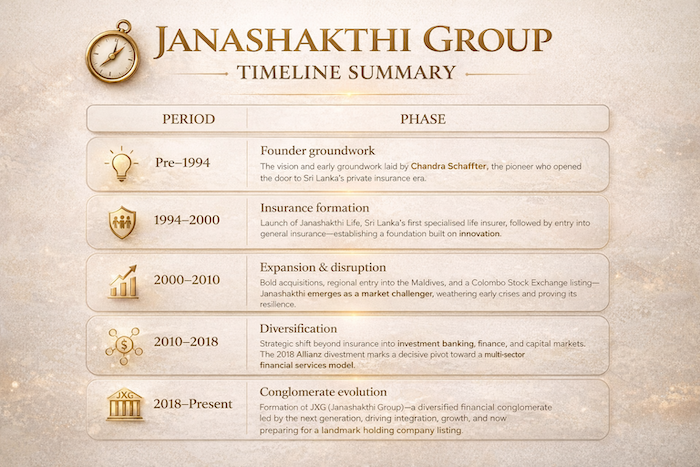
The early 2000s marked Janashakthi’s transition from challenger to established player. Strategic acquisitions and overseas expansion including entry into the Maldives broadened its footprint, while its 2008 listing on the Colombo Stock Exchange signaled institutional maturity.
Yet the path was not without disruption. Regulatory pressures and solvency concerns briefly tested the company’s foundations toward the end of the decade. For many firms, such episodes prove defining in a negative sense. For Janashakthi, they became part of an institutional learning curve forcing tighter governance, capital discipline, and strategic recalibration.
As the company entered the 2010s, leadership gradually transitioned to the second generation of the Schaffter family most notably Prakash Schaffter, alongside Dinesh Schaffter and Ramesh Schaffter.
This generational shift did not merely preserve the founder’s legacy; it expanded it.
Under their stewardship, Janashakthi began moving beyond insurance into a broader financial services architecture. The acquisition of AIA’s general insurance business in 2015 briefly strengthened its market position, but it was the subsequent decision in 2018 to divest that same business to Allianz that revealed a deeper strategic logic.
The sale unlocked significant capital. Rather than doubling down on insurance, the group pivoted.
Rewriting its operating model, the Janashakthi Group steadily transformed from a traditional insurer into a broader financial ecosystem, consolidating its presence across multiple verticals including insurance with a renewed emphasis on life investment banking through First Capital Holdings PLC, finance and leasing operations through Janashakthi Finance PLC and Orient Finance PLC, and active participation in capital markets. This diversification was far from incidental; it reflected a deliberate strategic pivot toward a capital markets-driven model in which earnings could be generated from a network of interconnected financial streams rather than a single line of business. The subsequent rebranding to JXG formalised this transition internally marking a move toward greater integration across its businesses, while externally signaling a more ambitious, forward-looking identity.
The transformation of JXG has unfolded against the backdrop of Sri Lanka’s most severe economic crisis in decades. Yet, even amid this volatility, the group has delivered strong earnings growth, underpinned by its active participation in government securities markets, a steady expansion of its lending portfolios, and improved margins within its insurance operations. Increasingly, the interplay between its subsidiaries has emerged as a core strength, enabling the group to navigate macroeconomic shocks with a level of flexibility and resilience that single-sector peers have struggled to match.
The most consequential step now lies ahead.
JXG is preparing for a listing of its holding company, a move that would fundamentally reshape how the market values the group. The objective is clear: unlock embedded value across its businesses and elevate the group into the upper ranks of Sri Lanka’s corporate hierarchy.
For investors, the listing offers exposure to a diversified financial platform rather than a single operating entity. For the group, it provides access to deeper pools of capital—critical for scaling in a competitive and capital-intensive sector.
It is, in many ways, the logical culmination of a strategy decades in the making.
From Chandra Schaffter’s founding vision to the expansion driven by Prakash Schaffter, Dinesh Schaffter, and Ramesh Schaffter, the Janashakthi story has unfolded as a carefully calibrated evolution, marked by successive phases of disruption, expansion, crisis, reinvention, and ultimately integration. Today, the group stands at yet another inflection point. Should its planned listing materialise, JXG will emerge as more than just another diversified entity on the Colombo bourse; it will stand as a rare example of a Sri Lankan corporate that has continually reshaped itself in response to shifting markets, capital cycles, and generational leadership. In doing so, it edges closer to completing a transformation from a single-line insurance venture into a fully-fledged financial powerhouse.