

For much of the past decade, the triggers of public agitation in Sri Lanka have been predictable. Fuel shortages, electricity cuts and cooking gas queues have repeatedly served as catalysts for public anger. The 2022 economic crisis illustrated this vividly: queues for petrol and diesel became both a symbol of economic collapse and the spark that ignited nationwide protests.
Yet the next disruption capable of unsettling Sri Lanka’s economy and potentially its social stability may not originate at petrol pumps or gas depots. It may arise from something far less visible but far more central to the modern economy: the submarine cables that carry the country’s digital communications.
Sri Lanka’s economy and daily life have become deeply dependent on uninterrupted internet and communication networks, making digital connectivity almost as essential as electricity or fuel. Banking transactions, mobile payments, ride-hailing, food delivery, logistics, BPO operations, remote work, and even government services now rely on stable internet access. In urban centres like Colombo, a disruption to internet connectivity would instantly affect millions of people’s ability to work, communicate, and conduct financial transactions. Unlike petrol or gas shortages which often unfold gradually through queues an internet disruption is immediate and widespread, simultaneously affecting businesses, media, financial systems, and personal communication. In a highly connected society where smartphones are central to everyday life, a sudden loss of connectivity could generate frustration and economic anxiety far faster than traditional shortages, potentially triggering public agitation more quickly than outages of electricity, petrol, or cooking gas.
A recent naval incident south of the island offers a revealing glimpse of that vulnerability.
A maritime episode with deeper implications
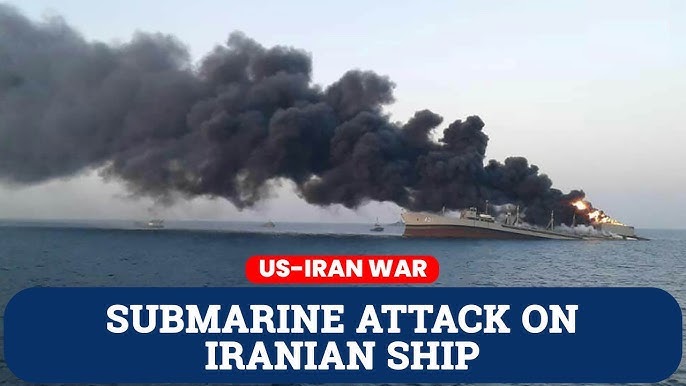
The reported sinking of an Iranian naval vessel roughly 40 nautical miles off Sri Lanka’s southern coast, amid tensions involving the United States and Iran, was initially framed as a geopolitical episode. Sri Lanka’s role — rescuing more than 200 sailors and providing humanitarian assistance was in keeping with international maritime obligations.
But the incident raises a broader question that policymakers in Colombo can no longer afford to ignore.
The waters south of Sri Lanka host a dense network of submarine cables that carry the overwhelming majority of global digital traffic. These cables underpin the functioning of modern economies. Banking transactions, cloud services, cross-border trade, business process outsourcing, logistics systems and routine internet connectivity all depend on them.
More than 99 per cent of international data traffic travels through submarine cables, according to industry estimates. The global network comprises roughly 500 systems spanning more than 1.7 million kilometres.
Despite their centrality, these systems remain largely invisible in economic debates, which tend to focus on digital platforms, artificial intelligence and data centres. Yet beneath those layers lies a more fundamental reality: without reliable cable infrastructure, the digital economy cannot function.
A strategic node in the Indian Ocean
Sri Lanka occupies a particularly exposed position within this global network.
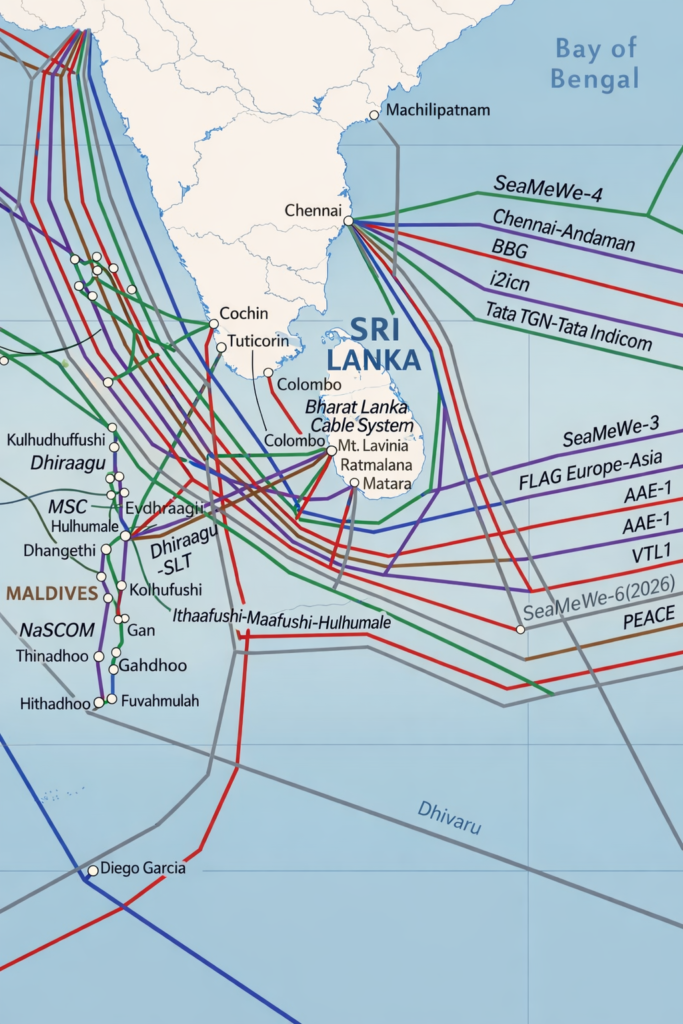
Multiple international cable systems land along the island’s western and southern coasts, including links associated with SEA-ME-WE routes, Bharat Lanka, BBG, Dhiraagu-SLT and MSC. Colombo serves as a major landing hub, Mount Lavinia provides direct connectivity with India, and Matara has emerged as a southern gateway for newer systems designed to improve network resilience.
In practical terms, Sri Lanka is not merely adjacent to undersea infrastructure. It forms part of the network’s architecture.
That geographical reality alters the strategic meaning of incidents occurring in nearby waters. A naval engagement, maritime accident or drifting vessel may appear isolated events, but in cable-dense environments they carry the potential to disrupt communications infrastructure that supports entire economies.
The risk of disruption is neither rare nor theoretical
Cable damage occurs more frequently than many assume.
The International Cable Protection Committee estimates that between 150 and 200 submarine cable faults occur globally each year, requiring constant repair operations. The majority are not acts of sabotage. They result from routine maritime activity, particularly fishing operations and ship anchors dragged across the seabed.
Anchoring incidents alone account for roughly 30 per cent of cable damage worldwide.
Sri Lanka has experienced the consequences firsthand. In 2004, damage to the SEA-ME-WE 3 cable — reportedly caused by a ship’s anchor disrupted international connectivity for several days, demonstrating how quickly a single incident can cascade through the economy when redundancy is limited.
What makes the present moment different is the geopolitical context.
The seabed as contested terrain
Across the world, governments are beginning to treat submarine cables as strategic infrastructure rather than purely commercial assets.
In the Baltic Sea, a series of incidents involving cables and pipelines has triggered investigations, naval deployments and a broader European effort to strengthen seabed surveillance. NATO has increased maritime monitoring, while the European Union has launched an action plan aimed at improving prevention, detection and rapid repair capabilities.
Asia is witnessing similar concerns. Taiwan has increased scrutiny of vessels operating near cable routes following a number of suspected incidents. Meanwhile, research announcements suggesting the development of specialised tools capable of cutting deep-sea cables have underscored how the physical layer of the internet is becoming an arena of geopolitical competition.
Even when intent remains ambiguous, the strategic implications are clear. Disrupting undersea infrastructure need not involve dramatic acts of sabotage. A damaged cable, delayed repair or unexplained disruption can create economic uncertainty and undermine confidence in digital systems.
The ambiguity itself can become a strategic instrument.
Sri Lanka’s emerging framework
Sri Lanka has begun to recognise these risks.
In 2021, the government launched a Submarine Cable Protection and Resilience Framework in collaboration with international partners including the International Cable Protection Committee. More recently, legislative reforms have strengthened the institutional framework for protecting undersea infrastructure.
The National Hydrographic Act of 2024 gives Sri Lanka’s hydrographic authorities responsibility for maintaining data and expertise relating to submarine cables. Amendments to the Sri Lanka Telecommunications Act established a National Submarine Cable Protection Committee that brings together regulators, maritime authorities, law enforcement agencies and industry operators.
These steps represent an important foundation.
Yet legislation alone cannot guarantee resilience. Effective protection requires operational integration combining maritime domain awareness, cable route monitoring, vessel traffic management and emergency repair capabilities.
Without such integration, legal frameworks risk remaining largely procedural.
A new dimension of economic vulnerability
The economic implications of a major cable disruption are significant.
Sri Lanka’s economy is increasingly dependent on digital infrastructure. The country’s large IT and business process outsourcing sector relies on uninterrupted international connectivity. Financial transactions, cross-border payments, logistics systems and even routine government services are now tied to digital networks.
A prolonged cable disruption would not simply slow internet speeds. It could impede banking operations, disrupt cloud-based services, affect port logistics and interrupt business continuity for export-oriented industries.
In an economy where millions depend on digital services for work, payments and communication, such disruption could quickly translate into economic anxiety.
The political consequences should not be dismissed. Sri Lanka’s recent experience demonstrates how rapidly economic frustration can escalate into broader agitation when essential systems fail.
From vulnerability to opportunity
At the same time, Sri Lanka’s geographical position also offers an opportunity.
The island sits near major cable routes linking Europe, the Middle East and Asia. Colombo Dockyard has already begun constructing advanced cable vessels intended to support subsea cable maintenance operations across the Indian Ocean. This capability could allow Sri Lanka to develop into a regional hub for cable repair and logistics.
In an era where resilience is becoming a strategic commodity, proximity to repair capacity is increasingly valuable.
Beyond industrial capacity, Sri Lanka could also play a diplomatic role. Regional co-operation on submarine cable protection — involving India, the Maldives and private operators — would reflect the shared interest of Indian Ocean economies in safeguarding digital infrastructure.
The unseen foundations of the digital economy
For decades Sri Lanka has emphasised its strategic importance through shipping lanes, ports and maritime trade.
Yet the Indian Ocean is no longer defined solely by the movement of ships. It is also defined by the flow of data beneath the seabed.
The cables running across the ocean floor form the invisible infrastructure that connects financial markets, digital platforms and national economies. Disruptions to those systems can carry consequences that extend far beyond the telecommunications sector.
The incident south of Galle should therefore be interpreted less as a dramatic naval episode and more as a reminder of the vulnerabilities embedded in the infrastructure of the digital age.
In the twenty-first century, an economy need not be blockaded to be disrupted.