

Sri Lanka has opened its doors to the world’s digital nomads – but at what price are we pitching ourselves?
At a minimum income threshold of USD 2,000 a month, the arithmetic tells its own uncomfortable story. That translates to roughly $66 a day. Bring along a partner – as many do – and the effective spend drops to just $33 per person per day.
Is $33 a day the benchmark for a country seeking to rebuild, reposition, and rise?
Be that as it may, this is not an argument for exclusion. It is an argument for strategy. Because what Sri Lanka is signalling to the world is not simply openness – but openness at the lower end of the global remote work spectrum.
There is a difference between volume and value.
At $33 a day, you are not driving premium tourism. You are not catalysing high-value ecosystems. You are not meaningfully lifting local enterprise. You are, quite simply, counting heads – not counting impact.
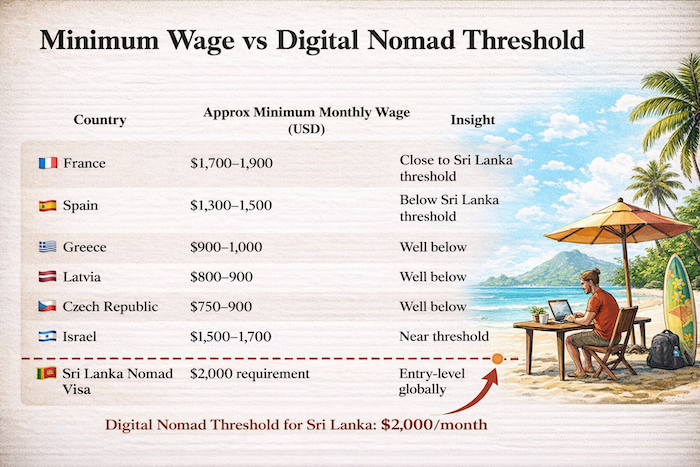
Sri Lanka’s USD 2,000 threshold is not a premium filter. It sits at – or just above – minimum wage levels in parts of Europe.
Let that sink in.
This means Sri Lanka is not primarily attracting:
Senior consultants
Tech founders
High-value remote professionals
Instead, it is opening its doors to: Entry-level earners
Junior freelancers Cost-sensitive remote workers
THE STRATEGIC PROBLEM
A person earning:
$2,000 in Europe is managing survival $2,000 in Sri Lanka is optimising cost
And what follows?
They spend carefully. They negotiate rents. They optimise every dollar. They live, spend, within their own WhatsApp bubble: some even rent tuktuks and drive themselves around – no spreading of the economy there. (One item to blame: giving licenses on arrival, even if most have never handled a tuk tuk in their dreams, let alone reality. Just saying.)
This is not luxury inflow. This is cost migration.
THE LINE THAT LANDS
Sri Lanka is effectively saying: “If you earn what a minimum wage worker earns in Europe – come live better here.” That may sound attractive. But economically? It is not a high-value proposition for the country.
THE MISSED STRATEGY
ComparethiswithcountrieslikeIndonesiaandThailand, where thresholds and financial filters are designed not just to attract people – but to curate economic contribution.
Sri Lanka, meanwhile, risks becoming:
A beautiful island… priced like a budget workaround.
WHAT SHOULD BE DONE
The answer is not to close the door – but to recalibrate it. Raise the threshold to $3,500–$5,000
Introduce tiered visa categories (mid-tier vs premium) Tie approvals to spending capacity, not just income Focus on value per person, (a couple would be 2 visas no dependents allowed) not volume of arrivals
THE BOTTOM LINE
Sri Lanka is benchmarking itself not against the top tier of Lisbon or Bali – …but against Europe’s minimum wage floor.
And that is the wrong league.