“As of 31 December 2025, the Bank’s internal control systems were assessed as adequate and effective, with no audit qualification raised by external auditors—an assurance that now sits in stark contrast to the scale of the fraud uncovered months later.”
The Numbers Before the Shock
The year ended 31 December 2025 was, by conventional metrics, strong:
* Net profit (FY2025): LKR 11.0 billion
* Q4 2025 profit: LKR 3.5 billion
* Total assets (early 2026): LKR 990 billion
The Shock: Rs 13.2 Billion
The bank’s disclosure confirms:
- Fraud size: LKR 13.2 billion
- Confined to a specific operational area
- Full provisioning assumed in worst-case scenario
Interpretation:
- The fraud equals ~120% of annual profit
- But only ~1.3% of total assets
This asymmetry defines the story:
👉 It is a profit event, not a balance sheet collapse.
In Sri Lanka’s tightly interconnected banking system, where trust travels faster than capital, a single number has begun to echo across dealing rooms, boardrooms, and investor circles alike: Rs 13.2 billion.
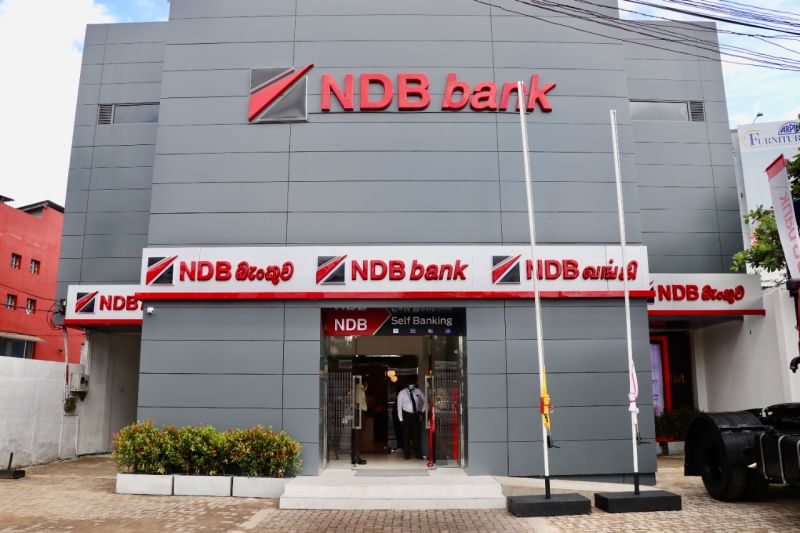
That is the estimated size of an internal fraud uncovered at National Development Bank PLC (NDB), one of the country’s leading listed commercial banks. On paper, the loss is manageable. In practice, it has raised a more unsettling question not how much was lost, but how it happened at all.
A Profitable Bank, Suddenly in the Red
At the close of 2025, NDB appeared to be regaining its footing after Sri Lanka’s economic crisis. The bank reported Rs 11 billion in net profit for the year, with a strong final quarter performance reinforcing its recovery trajectory.
Then came the disclosure.
Following an internal investigation, the bank confirmed that fraud—contained within a specific operational area—amounted to approximately Rs 13.2 billion. The financial consequence was immediate. After making provisions, the bank is now expected to report a loss in early 2026, reversing its prior profitability.
In effect, an entire year of earnings has been wiped out.
Big Number, Small Percentage
Yet the scale of the loss tells two different stories.
Relative to earnings, the fraud is severe—larger than annual profit. But relative to the bank’s balance sheet, it is modest. With an asset base approaching Rs 1 trillion, the impact represents less than 1% of total assets.
The bank has been quick to emphasize this distinction.
It says capital ratios remain above regulatory requirements. Liquidity is intact. Customer deposits are unaffected. Day-to-day operations continue without disruption.
From a regulatory standpoint, this is not a failing bank.
But from a psychological standpoint, it is a tested one.
The Question Beneath the Numbers
What has unsettled analysts is not the loss itself, but the pathway to it.
For a fraud to accumulate to Rs 13.2 billion, it must evade multiple layers of control—internal audits, transaction monitoring systems, and supervisory oversight. In banking, these safeguards are designed not just to detect wrongdoing, but to prevent it from escalating.
Their failure, even in a single unit, raises uncomfortable questions.
Was this an isolated breach—or evidence of deeper control weaknesses?
The bank has responded swiftly: suspending implicated staff, tightening internal controls, and initiating an independent forensic audit. Law enforcement authorities are now involved.
But investigations take time. Markets react instantly.
Regulators Move to Contain Risk
The Central Bank has stepped in with a mix of support and restraint.
While backing the bank’s stability, it has imposed precautionary measures—halting cash dividends, restricting discretionary spending, and limiting expansion activities. These steps are designed to preserve capital and ensure stability during the investigation period.
They also signal that authorities are taking the incident seriously.
Contagion—or Containment?
So far, the incident appears contained within NDB, with no evidence of spillover into the wider banking system.
But Sri Lanka’s recent financial history means confidence remains fragile. In such an environment, perception can move as quickly as liquidity.
Bank runs are rarely triggered by balance sheet weakness alone. They begin with doubt.
For now, depositor confidence appears steady, and the bank’s liquidity position remains strong. Regulatory oversight provides an additional layer of reassurance.
Still, the episode has introduced a new variable into the system: uncertainty.
A Turning Point
NDB insists it remains financially strong—and by most conventional measures, it does.
But the challenge it now faces is not purely financial.
It must rebuild trust.
That will require more than absorbing a loss. It will require convincing stakeholders—depositors, investors, regulators—that the systems meant to safeguard funds are robust, reliable, and resilient.
For NDB, the path ahead is no longer just about profitability.
It is about credibility.
And in banking, credibility is everything.