
Sri Lanka’s coal story never travels alone. It travels with allegations. It travels with procurement questions. And now, it travels with ash.
In recent weeks, concerns have resurfaced over the supply of coal to the Norochcholai Coal Power Plant — the country’s single largest source of base-load electricity. Norochcholai produces nearly one-third of Sri Lanka’s power. When it functions well, the lights stay on. When it falters, the grid trembles.
But coal is not just about megawatts. It is about money.
Coal tenders in Sri Lanka have long been controversial. Questions over pricing mechanisms, quality standards, middlemen, and supplier selection have surfaced repeatedly over the years.
Each new shipment arrives not just with fuel — but with scrutiny. Allegations of irregular procurement processes and inflated costs have been raised in past cycles, and they refuse to die quietly.
Now, a different layer of concern has taken centre stage.
The ash. Environmental groups are warning that increasing coal imports mean increasing ash output — and that Sri Lanka is not equipped to manage it safely.
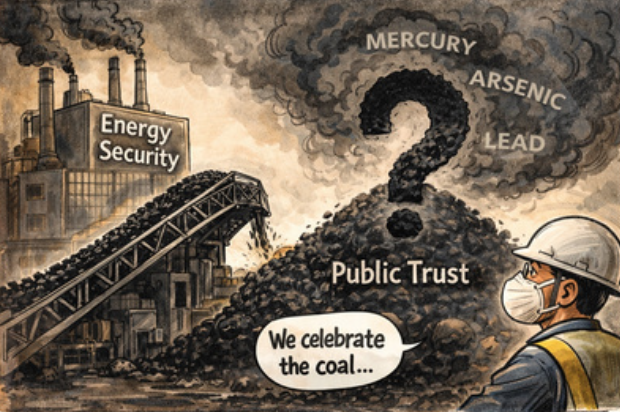
Hemantha Withanage, environmental scientist and Chairman of the Centre for Environmental Justice (CEJ), did not mince his words. He described the rising ash volumes as something authorities appear to “celebrate as a blessing,” while in reality it poses what he calls a major ecological threat.
“More coal and more ash are being celebrated as a blessing. People around Norochcholai should get ready to apply it on their foreheads — and this will affect everyone, regardless of political affiliation,” he said.
It is provocative language.
But the science behind it is not theatrical.
Norochcholai generates thousands of tonnes of fly ash and bottom ash every year. Environmentalists argue that significant portions are inadequately stored, or disposed of without comprehensive environmental safeguards.
Coal ash is not harmless dust.
It contains heavy metals — mercury, arsenic, cadmium, lead. If improperly handled, it can seep into soil, groundwater and marine ecosystems. If airborne, it becomes a respiratory hazard. If leached into water systems, it enters food chains.
Withanage is blunt: “Coal ash is not ordinary waste. It is hazardous industrial material.”
And here lies the structural contradiction.
On one hand, Sri Lanka depends on coal for grid stability. Renewable transition remains gradual. Hydro fluctuates with rainfall. Thermal back-up remains expensive.
On the other hand, the more coal imported, the more ash produced.
And Sri Lanka does not yet have a comprehensive, transparent national policy governing coal ash management. There are calls for secure storage facilities, independent monitoring, and strict regulatory frameworks before recycling ash into construction materials — a practice used elsewhere but tightly controlled.
Without standards, recycling itself can become a contamination pathway.
Meanwhile, the corruption question hovers in the background. If procurement processes lack transparency, if quality testing is inconsistent, if tender structures are repeatedly challenged — public confidence erodes.
Energy security cannot operate in a fog.
Norochcholai has already faced controversy since commissioning — technical failures, marine impact concerns, maintenance lapses. It remains indispensable. But indispensability does not mean immunity from oversight.
Sri Lanka stands at an uncomfortable intersection: