

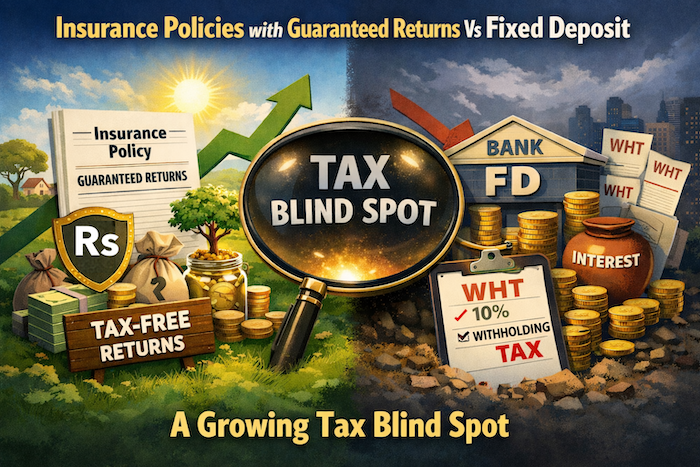
A troubling distortion is quietly taking root in Sri Lanka’s financial system: certain insurance companies are effectively accepting deposits from customers under the guise of insurance policies, promising fixed or quasi-fixed returns that closely resemble bank deposit interest without deducting withholding tax (WHT). While dressed up as “insurance” or “investment-linked” products, many of these schemes function in substance like deposit instruments. The result is a growing tax arbitrage that disadvantages compliant taxpayers, erodes public revenue, and undermines regulatory credibility.
At the heart of the issue is substance over form. Traditional insurance transfers risk; deposits do not. Yet some products are marketed primarily on guaranteed returns, short tenures, and liquidity features that mirror fixed deposits often with minimal risk coverage. Customers are attracted not only by the returns but by a critical omission: no withholding tax deduction at source, unlike bank deposits where WHT is automatic. This creates an uneven playing field, incentivizing savers to migrate funds away from banks and into insurance wrappers designed to sidestep tax.
This practice raises two serious concerns. First, it amounts to tax evasion (or, at best, aggressive avoidance) by exploiting regulatory silos. Second, it blurs prudential boundaries, exposing consumers to risks they may not fully understand—particularly if they believe these products carry bank-like safety while lacking equivalent oversight or guarantees.

The solution is not complicated, but it requires coordination. The Central Bank of Sri Lanka and the Insurance Regulatory Commission of Sri Lanka must work together to harmonize rules based on economic reality. Where a policy behaves like a deposit capital-protected, return-focused, and low on genuine risk transfer it should be taxed like a deposit. A uniform tax treatment, including mandatory WHT at source on deposit-like returns, would immediately close the loophole.
Beyond taxation, regulators should tighten product classification and disclosures, enforce clear separation between risk cover and savings, and prevent marketing that implies guaranteed returns without commensurate capital and consumer protections. Banks should not be penalized for compliance while parallel products escape equivalent obligations.
Sri Lanka cannot afford regulatory blind spots at a time of fiscal consolidation. Allowing deposit-like products to masquerade as insurance undermines tax fairness, distorts savings allocation, and weakens trust in oversight. Uniform taxation anchored in substance not labels is essential. Coordinated action by the Central Bank and the Insurance Regulator would restore balance, protect consumers, and ensure that everyone plays by the same rules.