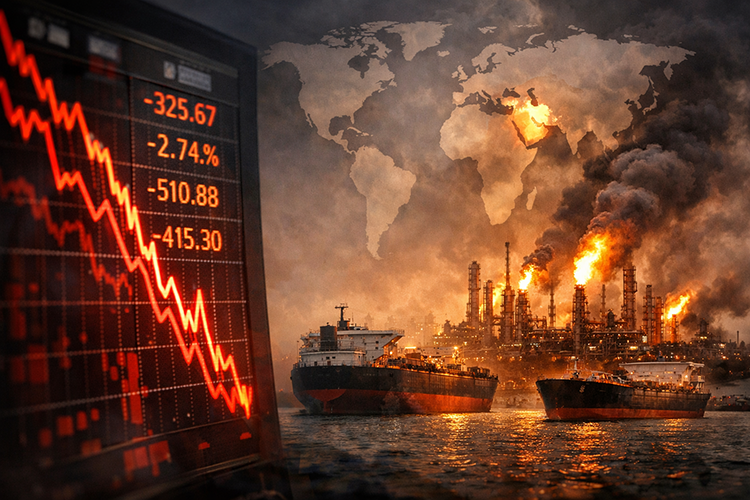
The effects of higher oil prices and declining equity markets would be the main drivers of the negative global economic impact from an adverse scenario in which the Iran conflict continued until the end of the first half of 2026, according to Fitch Ratings. Their cross-sector analysis indicates that global real GDP would be approximately 0.8% lower after four quarters compared to their base case published in the March Global Economic Outlook (GEO).
Fitch Ratings estimated the macroeconomic impact of the adverse scenario using the Oxford Economics Global Economic Model. Higher oil prices would negatively affect economic growth most significantly in Korea, Japan, and the United States, while falling equity prices would have the strongest impact in Canada, Korea, and the US. Wealth effects from lower share prices account for roughly half of the downward impact on US GDP under this scenario. Several emerging markets would also experience slower growth due to increased spreads in emerging-market bond indices.
In the March GEO, real GDP growth was forecasted at 2.2% in the US, 4.3% in China, and 1.3% in the eurozone for 2026, with world growth projected at 2.6%. However, under the adverse scenario, growth in the US this year would be 1.5%, while growth in China would fall below 4%, and in the eurozone, it would drop below 1%.
The modelling demonstrates that the maximum impact from the adverse scenario occurs four quarters after the initial shock, revealing effects that are even more pronounced than the weaker annual average growth performance suggests. In the fourth quarter of 2026, US real GDP growth would be just 0.6% year-on-year in the adverse scenario, compared to 1.8% in the GEO. Eurozone growth would also be 0.6% year-on-year in 4Q26, compared to 1.5%, while world growth would register at 1.7% versus 2.5%.
In the adverse scenario, inflation among the ‘Fitch 20’ economies would be 1.3 percentage points higher after four quarters than under the GEO. Countries such as India, Poland, and Turkiye would experience inflation increases exceeding 2 percentage points. However, the estimates for the scenario’s impact on inflation do not account for any fiscal policy measures that governments may implement to cap or limit energy price increases, which could mitigate the scenario’s inflationary effects.
Fitch Ratings does not anticipate significant tightening of monetary policy in the US, EU, or UK under the adverse scenario. This is partly due to the differing inflationary conditions compared to the energy price surge in 2022, which occurred amid labor shortages, supply chain disruptions, and substantial fiscal stimulus.
The post Oil, Equity Prices Shape Iran War Adverse Scenario Macroeconomic Impact appeared first on Financial Chronicle Biz English | Sri Lanka Business News.