


JKH Yield will be Rs 2.65 per Rs 100
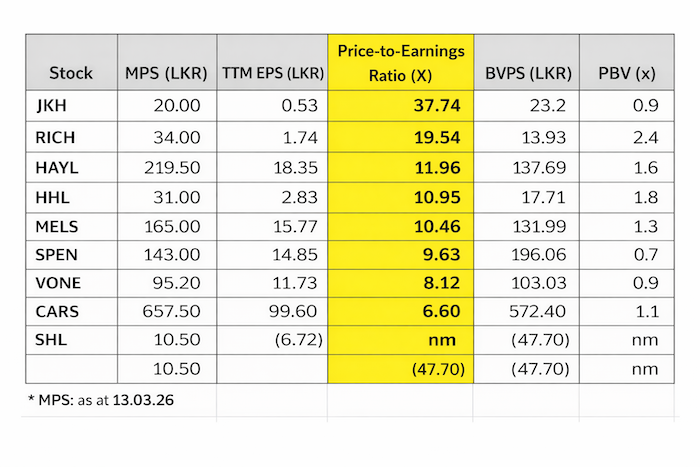
A glance at the valuation table of several leading companies listed on the Colombo Stock Exchange offers an interesting lesson in how markets price expectations. Take John Keells Holdings (JKH), widely regarded as one of Sri Lanka’s premier corporate groups. Based on the figures in the table, JKH trades at a price-to-earnings ratio of 37.74.
What does this mean in simple terms for an investor?
If a NewsLine reader were to place Rs 100 into JKH, the company’s current earnings represent roughly Rs 2.65 per year, or about 2.65 percent.
That figure naturally invites comparison. At present, ordinary bank deposits in Sri Lanka are yielding roughly 8 percent, meaning a saver placing Rs 100 in a bank account could expect about Rs 8 annually.
Why then would investors buy JKH shares?
Because markets often price future growth rather than present earnings. Investors appear willing to pay a premium for JKH based on expectations tied to tourism recovery, property development, the financially challenging City of Dreams project and the broader economic outlook for Sri Lanka.
Be that as it may, the same exercise applied to another company in the table produces a very different result.
Consider Carsons Cumberbatch PLC (CARS). With a P/E ratio of around 6.6, the earnings yield becomes much higher. In simple terms, Rs 100 invested in Carsons would represent roughly Rs 15.50 in annual earnings, equivalent to a yield of about 15.5 percent.
On paper, that appears far more attractive.
However, there is an important caveat. Carsons shares are highly illiquid, meaning only a small proportion of shares are freely traded in the market. Much of the company remains tightly held by controlling shareholders. This limited public float makes it more difficult for investors to buy or sell shares easily.
Looking across the rest of the table, companies such as Hayleys PLC, Melstacorp PLC,Vallibel One
and Aitken Spence PLC appear to trade in a more conventional range of roughly 8 to 12 times earnings, suggesting the market considers them broadly fairly priced relative to current profits.
In other words, the table highlights the contrast between growth expectations and present earnings.
Disclaimer: Investments in shares can go up as well as down. Investors should remember that the value of shares may fall and you could lose part or all of your initial investment.