
The surge in global oil prices triggered by the Middle East crisis is already translating into a significantly higher fuel bill for Sri Lanka.
With Brent crude now trading around $100 per barrel amid fears of disruptions to Gulf shipping routes, the island’s import costs have jumped sharply compared with prices earlier this year.
Only a few weeks ago, in late February 2026, Brent crude was trading close to $70–72 per barrel.
The current level therefore represents roughly a 40% increase in global oil prices within a short period, driven by the escalating conflict and threats to shipping through the Strait of Hormuz, the corridor carrying about one-fifth of the world’s oil supply.
For Sri Lanka the financial implications are immediate.
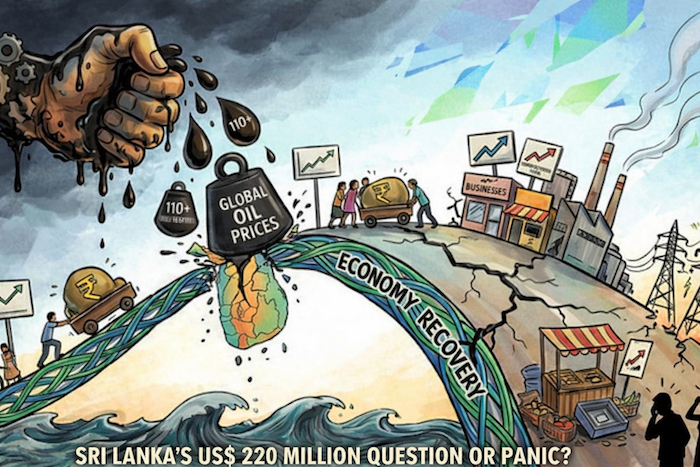
A typical crude shipment for the Sapugaskanda refinery is about 100,000 metric tons, equivalent to roughly 730,000 barrels of oil. At the earlier price of $70 per barrel, such a cargo would have cost around $51 million. At today’s price of about $100 per barrel, the same shipment costs roughly $73 million.
That means Sri Lanka is now paying about $22 million more for each crude cargo.
Sri Lanka usually imports around 10 crude cargoes a year, meaning the additional annual cost could approach $200–220 million if prices remain at current levels.
And that figure reflects crude oil alone.
The country also imports large quantities of refined products such as diesel, petrol, jet fuel and LPG, most of which arrive from India or Singapore. Overall, Sri Lanka already spends close to $3.8 billion annually on fuel imports, making energy one of the largest drains on foreign exchange.
Be that as it may, the real risk lies not only in price but in supply. If disruptions around the Gulf intensify, physical cargoes could become harder to secure, pushing premiums even higher.
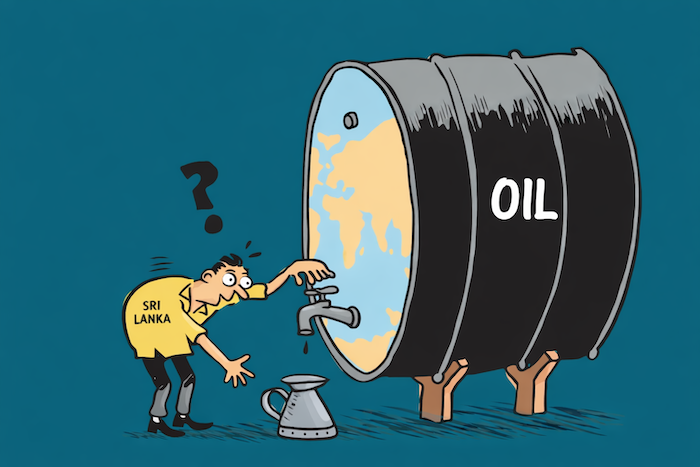
For Sri Lanka — an island economy dependent on imported energy — the rising oil price is more than a market statistic.
It is a reminder that when geopolitics shakes the world’s energy arteries, the shock quickly reaches the pumps at home.