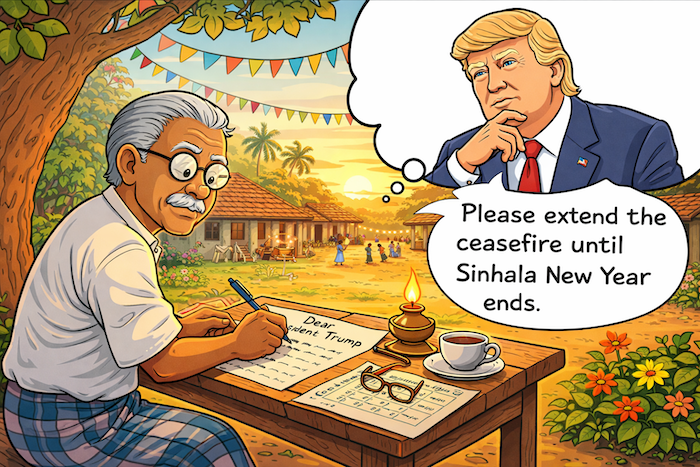
In a quiet corner of a sunlit Sri Lankan village, beneath the shade of a margosa tree, Punchi Singho sat with his sarong neatly folded, an old radio humming with distant global tensions, and a cup of plain tea slowly losing its warmth. The world beyond his village sounded restless filled with urgency, strategy, and the echo of possible conflict. But Punchi Singho, as always, was thinking about something else.
“Timing,” he said softly, adjusting his spectacles. “Everything depends on timing.”
Today, his thoughts were directed toward one man Donald Trump and the news that had just reached even this quiet village: a decision to delay war by ten days.
Punchi Singho nodded with quiet approval.
“That is good… very good. To wait, even a little, is wisdom,” he murmured.
But as he unfolded his nakath seettuwa, his expression grew thoughtful. His finger rested firmly on one moment April 14th, 9:32 AM.
“Waiting is good,” he said, “but waiting correctly is better.”
For Punchi Singho, the Sinhala and Tamil New Year Avurudu is not just a celebration. It is a cosmic turning point. It marks the transition of the sun from Pisces to Aries, a moment when time itself pauses between endings and beginnings. This sacred pause, known as Nonagathe, is when all activity stops, no work, no transactions, no conflict only reflection and renewal.
“In our belief,” Punchi Singho explained, “even the universe rests before it begins again.”
Village stories passed down through generations say that during this time, Indra, the bringer of peace, descends to earth, watching how humans begin their new year. Homes are cleaned, hearts are softened, and even long-standing grudges are quietly set aside.
“If we can forgive each other,” he asked gently, “why can’t nations do the same… at least for a few days?”
Punchi Singho leaned back and began composing, in his mind, a second letter.
“Dear Mr. President,”
“I heard that you have delayed matters by ten days. For that, I thank you. It shows understanding — because even waiting a little can change the direction of events.”
“But Sir, with great respect, I humbly feel that your advisors may not have considered something important not just how long to wait, but until when.”
“In Sri Lanka, we do not begin anything important without the right time. This year, our New Year dawns on April 14th at exactly 9:32 in the morning. Even something as simple as boiling milk is done only at the correct minute.”
“If we can wait to light a hearth… surely the world can wait to light conflict.”
Punchi Singho paused, choosing his words carefully.
“Sir, you are known to value strength, strategy, and winning. In our tradition, the greatest advantage comes not from speed, but from alignment when action follows the movement of the sun.”
“Even your horoscope, like all of ours, must move with this change. If action is taken after these auspicious hours after the rituals, after the blessings it is believed to carry less resistance and greater clarity.”
Outside, the village was already preparing for Avurudu. Women were drying sweetmeats in the sun, children rehearsing games, and homes being cleaned as if welcoming not just a new year, but a new state of mind.
“To fight now,” Punchi Singho whispered, “is like starting an argument in the middle of a wedding… it breaks the spirit of the moment.”
He returned to his letter with renewed sincerity.
“So I humbly request,”
“Please consider extending this pause not just for ten days, but until the sacred period of Avurudu has passed.”
“From April 14th at 9:32 AM, through the rituals of April 15th, and if possible, until April 20th when we return to work – allow the world a moment to reset.”
“This is not weakness, Sir. This is strength guided by time.”
With a small smile, he added:
“Let the only explosions be our firecrackers.
Let the only competitions be our Avurudu games.
Let the world begin again properly.”
As the evening sun dipped low, Punchi Singho folded his imaginary letter and placed it beside the softly glowing oil lamp near the Buddha statue in his home. The flame stood steady patient, unwavering.
And with quiet conviction, he whispered a final thought carried not just by him, but perhaps by many:
“Thank you for waiting, Sir… now please wait for the right moment. Because timing, more than power, decides how the story ends.”