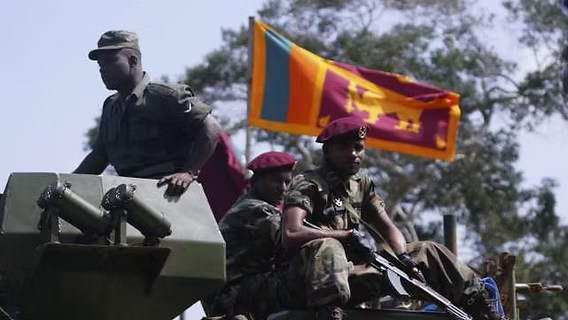
COLOMBO – In May 2009, Sri Lanka’s security forces brought a decisive end to nearly three decades of war against the LTTE. It was, by any measure, a military victory – swift in its conclusion, total in its outcome, and controversial in its conduct. The guns fell silent. The state prevailed. And a nation long battered by conflict stepped into what was promised to be a new chapter.
But nearly a generation on, a harder question persists. Did SriLanka win the war-or has it yet to win the peace?
Be that as it may, military success does not automatically translate into national reconciliation. The end of the conflict created an opportunity – perhaps the greatest in modern Sri Lanka – to rebuild trust, address grievances, and heal wounds that had deepened over decades. That opportunity, many argue, remains only partially realised.
Reconciliation is not a declaration. It is a process.
And central to that process is acknowledgment.
Across the Northern and Eastern provinces, questions remain over those who were unaccounted for in the final stages of the war. Families continue to seek answers. Names remain unresolved. Silence, in many cases, has replaced closure. Governments have established commissions, gathered testimony, and issued reports. Yet for many affected communities, these efforts have not translated into the one thing they seek most: certainty.
This is where the debate sharpens.
Could the state, without undermining its military victory, take a more direct step? Could it acknowledge that in the fog and fury of battle, unsalubrious things may have occurred – events that were neither recorded nor fully understood – and offer an apology to those who carry the trauma?
Such an acknowledgment need not be an admission of systematic wrongdoing. It could instead be a recognition of human cost – an expression of empathy grounded in the reality that war, however justified, leaves scars beyond the battlefield.
Be that as it may, the absence of such a gesture has left a vacuum.
Reconciliation cannot be built on infrastructure alone. Roads, schools, and economic development matter – but they do not replace dignity, recognition, or closure. Nor can reconciliation be sustained through political rhetoric. It requires credibility, consistency, and above all, trust.
Sri Lanka today stands at a quiet but critical juncture. The war was won. That is not in dispute.
But the battle for lasting peace – for a shared national narrative that includes all communities – remains unfinished.
And until that battle is addressed with honesty and courage, the victory of 2009 will continue to echo with an unanswered question.