
On Tuesday, the International Monetary Fund (IMF) revised its growth projections downward, attributing the change to surges in energy prices driven by ongoing conflict in the Middle East. The organization indicated that the global economy is veering towards potentially more challenging outcomes, characterized by significantly reduced growth as disruptions in shipping through the Strait of Hormuz persist.
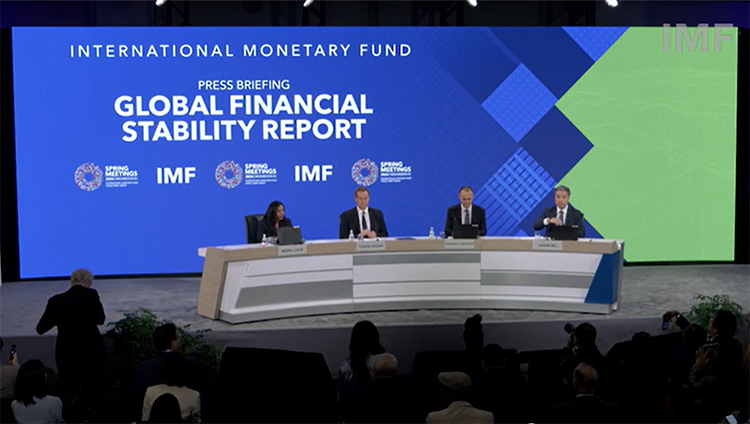
With heightened uncertainty surrounding the Middle Eastern conflict, finance officials convened for the IMF and World Bank spring meetings in Washington. During this gathering, the IMF outlined three potential growth scenarios: weaker, worse, and severe, depending on the developments of the ongoing war.
In the IMF’s most pessimistic scenario, the global economy is on the verge of recession, predicting average oil prices of $110 per barrel in 2026 and $125 in 2027.
For its reference forecast in the World Economic Outlook, the IMF opted for a more optimistic scenario, one that assumes a brief conflict with oil prices expected to stabilize in the latter half of 2026, averaging $82 per barrel for that year—significantly lower than the current benchmark Brent crude price of approximately $96.00.
Shortly after the announcement, IMF chief economist Pierre-Olivier Gourinchas cautioned that the forecast may already be outdated. He noted that ongoing energy disruptions and the lack of a clear resolution to the conflict make the IMF’s adverse scenario more probable.
The middle scenario posits a prolonged conflict, keeping oil prices around $100 per barrel this year and $75 in 2027, with global growth anticipated to decline from 3.4% in 2025 to 2.5% this year.
“We find ourselves somewhere between the reference and adverse scenarios,” Gourinchas stated. “As each day passes with continued energy disruptions, we inch closer to the adverse scenario.”
If the Middle East tensions were resolved, the IMF suggested it could have raised its growth outlook by 0.1 percentage points to 3.4%, supported by ongoing technological investments, lower interest rates, reduced U.S. tariffs, and fiscal support in select nations.
Previously, in January, the IMF had anticipated that oil prices would drop to around $62 by 2026.
The IMF’s most severe scenario foresees an extended and escalating conflict resulting in significantly higher oil prices, which could lead to major financial market disruptions and tighter financial conditions, reducing global growth to just 2.0%.
“Such a situation would place the global economy at risk of recession,” the IMF remarked, noting that growth has dipped below this level only four times since 1980, including during the last two major recessions in 2009 and 2020.
Gourinchas indicated that several countries could enter outright recessions under this bleak scenario, where oil prices average $110 per barrel in 2026 and $125 in 2027. Prolonged high prices would elevate inflation expectations, leading to broader price increases and wage demands.
“This shift in inflation expectations will compel central banks to tighten monetary policy to rein in inflation,” he explained, suggesting that this could require more stringent measures than were seen in 2022.
Despite the challenges, the IMF noted that central banks might be able to overlook a temporary surge in energy prices and maintain steady interest rates amid weaker economic activity, essentially easing monetary policy, provided that inflation expectations remain stable.
For 2026, global inflation in the severe scenario is projected to exceed 6%, compared to 4.4% in the more optimistic reference scenario, which informs the IMF’s forecasts for various countries and regions.
The IMF also adjusted its growth forecast for the United States this year to 2.3%, a slight decrease of 0.1 percentage points from January, reflecting the positive impact of tax cuts, delayed effects from interest rate reductions, and continued investment in AI data centers, which are helping to offset rising energy costs. The growth rate for 2027 is now expected to be 2.1%, an increase of 0.1 percentage points from earlier estimates.
The eurozone, still grappling with elevated energy prices linked to Russia’s invasion of Ukraine in 2022, faces a sharper impact from the Middle East conflict, with growth forecasts for both 2026 and 2027 reduced by 0.2 percentage points, now expected to be 1.1% and 1.2%, respectively.
Japan’s growth outlook remains relatively stable, projected at 0.7% for 2026 and 0.6% for 2027 under the most favorable scenario, although the IMF anticipates that the Bank of Japan may raise interest rates more rapidly than previously expected.
The IMF has lowered its growth forecast for China to 4.4% for 2026, a slight decrease of 0.1 percentage points from January. This is attributed to increased energy and commodity costs, which are being partially offset by reduced U.S. tariffs and government stimulus. However, challenges such as a struggling housing market, a shrinking labor force, declining investment returns, and slower productivity growth are expected to reduce China’s growth to 4.0% in 2027, consistent with earlier predictions.
Emerging markets and developing economies, which typically have greater exposure to fluctuations in oil prices, are projected to suffer more from the Middle East conflict compared to advanced economies, with growth for 2026 anticipated to drop by 0.3 percentage points to 3.9%.
This impact is particularly severe in the Middle East and Central Asia, where GDP growth for 2026 is expected to plummet by two full percentage points to 1.9%, driven by significant infrastructure damage and sharply reduced energy and commodity exports.
Forecasted GDP declines for 2026 include 6.1% for Iran, 8.6% for Qatar, 6.8% for Iraq, 0.6% for Kuwait, and 0.5% for Bahrain.
However, if the conflict proves to be short-lived, the region is projected to recover swiftly, with GDP growth rebounding to 4.6% in 2027, a 0.6 percentage point increase from earlier forecasts.
Amid these challenges, India stands out with growth projections increased by approximately 0.1 percentage points to 6.5% for both 2026 and 2027, aided by strong growth momentum from late last year and a deal to reduce U.S. tariffs on Indian exports.
The IMF mentioned that governments might feel pressured to implement fiscal measures to alleviate the burdens of rising energy prices, such as price caps, fuel subsidies, or tax reductions. However, it advised caution, given current high budget deficits and increasing public debt levels.
Gourinchas acknowledged the legitimacy of wanting to protect vulnerable populations, but he cautioned that subsidies in one country could lead to shortages in others that cannot afford such measures.
“It is essential to approach this in a very targeted and temporary manner to avoid disrupting the fiscal framework that many countries need to stabilize their budgets,” he concluded.